SOCIAL & EMOTIONAL SKILLS
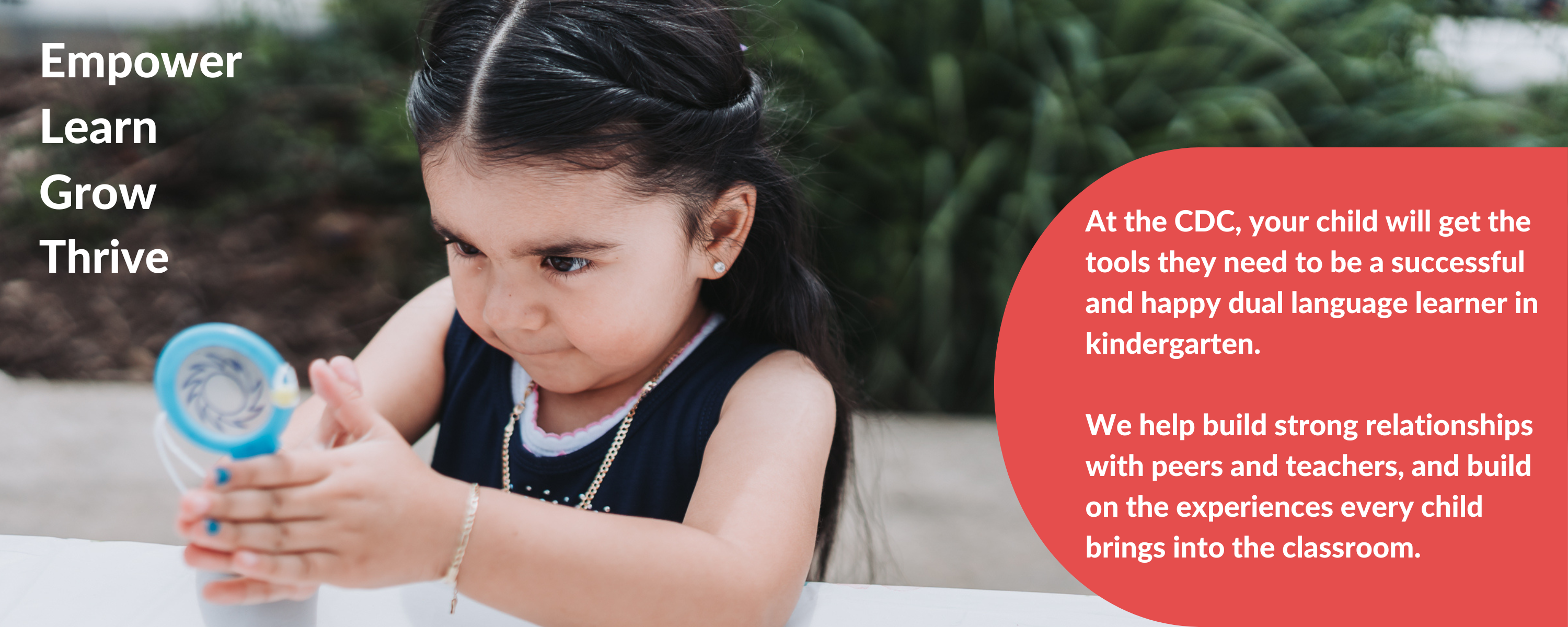
Young learners are inspired to be kind problem-solvers with a growth mindset. Through teacher-led projects and playtime, students build healthy relationships, express and make choices, and understand and talk about their feelings.
DUAL LANGUAGE LEARNING
Bilingual teachers lead discussions, activities, ignite creativity, and language development. Students learn rhymes, gain exposure to reading and writing, and engage in problem solving in English and Spanish.
AMAZING TEACHERS
From Mexico, El Salvador, Venezuela, and Peru, our teachers come from all over Latin America. Passionate and experienced in developing skills for dual-language young learners, they are constantly continuing their education.
Want to schedule a tour? 
 QUICK FACTS
100% of our teachers are bilingual
90% of our students are bilingual
89% of parents are fully satisfied
1 teacher for every 8 students
HOW TO ENROLL
To get started, please contact:
Parent Engagement Coordinator
[email protected]
415.401.4253
Come Join our Teaching Staff
Good Samaritan is hiring Child Development Center Bilingual Teachers! Come join our team! experiences!
Contact: Mary Gaston [email protected]
Child and Adult Care Food Program (CACFP)
Non-Discrimination Statement
In accordance with Federal civil rights law and U.S. Department of Agriculture (USDA) civil rights regulations and policies, the USDA, its Agencies, offices, and employees, and institutions participating in or administering USDA programs are prohibited from discriminating based on race, color, national origin, religion, sex, disability, age, marital status, family/parental status, income derived from a public assistance program, political beliefs, or reprisal or retaliation for prior civil rights activity, in any program or activity conducted or funded by USDA (not all bases apply to all programs). Remedies and complaint filing deadlines vary by program or incident.
Persons with disabilities who require alternative means of communication for program information (e.g., Braille, large print, audiotape, American Sign Language, etc.) should contact the State or local Agency that administers the program or contact USDA through the Telecommunications Relay Service at 711 (voice and TTY). Additionally, program information may be made available in languages other than English.
To file a program discrimination complaint, complete the USDA Program Discrimination Complaint Form, AD-3027, found online at How to File a Program Discrimination Complaint and at any USDA office or write a letter addressed to USDA and provide in the letter all of the information requested in the form. To request a copy of the complaint form, call (866) 632-9992. Submit your completed form or letter to USDA by: (1) mail: U.S. Department of Agriculture, Office of the Assistant Secretary for Civil Rights, 1400 Independence Avenue, SW, Mail Stop 9410, Washington, D.C. 20250-9410; (2) fax: (202) 690-7442; or (3) email: [email protected].
USDA is an equal opportunity provider, employer, and lender.